Rebel Angels
Paradise LostThe Rebel Angels are the host that follows Satan in his attempt to oppose God and establish an independent dominion. Once inhabitants of Heaven, they become the fallen population of Hell: defeated in open battle, deprived of their former glory and heavenly memorial, yet still immortal, organized, and capable of choosing renewed resistance. Their importance lies in this paradox. They lose the war without losing the will to continue it, and their military revolt becomes a wider spiritual and political infection that reaches humanity.
Identity and Formation
The Rebel Angels originate in Heaven as celestial powers who join Satan after his pride leads him to seek equality with God. Their revolt is not presented as an accidental disturbance but as an ambitious attempt to raise an opposing throne and monarchy. God casts Satan and his host down from the ethereal sky into Hell, where they remain overwhelmed by fiery ruin. The fall therefore changes their condition without erasing their nature as immortal spirits: they suffer pain, confusion, and humiliation, but they are not extinguished.
Their first collective appearance in Hell is marked by physical devastation and military discipline. They lie scattered in the fiery gulf, surrounded by flames that give no ordinary light but reveal a realm of suffering and visible darkness. Satan crosses the burning ground with a spear serving as a staff, reaches the shore of the infernal sea, and summons his legions. At his command, the fallen host rises from the fires and gathers upon the brimstone plain in numbers compared with immense swarms and invading armies. Their movement from scattered wreckage to assembled force establishes the central pattern of their history: defeat is immediately reorganized as collective action.
The group includes former Cherubim, Seraphim, and other powers who once occupied thrones and princely dignities in Heaven. Their heavenly names have been erased from the records of Heaven because of their rebellion. They do not yet possess the new names by which humanity will later know them; those names arise after they wander over Earth and corrupt human beings through falsehood, lies, idolatry, and elaborate religions. The Rebel Angels thus pass from a heavenly military identity into a demonic and cultural one, becoming known through the various idols and pagan deities they induce people to worship.
Organization and Political Rhetoric
Satan gives the defeated host a renewed sense of purpose by addressing them as princes, potentates, warriors, and the flower of Heaven. His speech turns their humiliation into a reason for action. He argues that the loss of Heaven has not destroyed their capacity for sovereignty and that their present unity may be stronger because Hell offers no lesser prize for ambitious rivals to covet. He presents himself as the foremost shield against God's power and claims that the exposed danger of leadership makes his rule acceptable to the others.
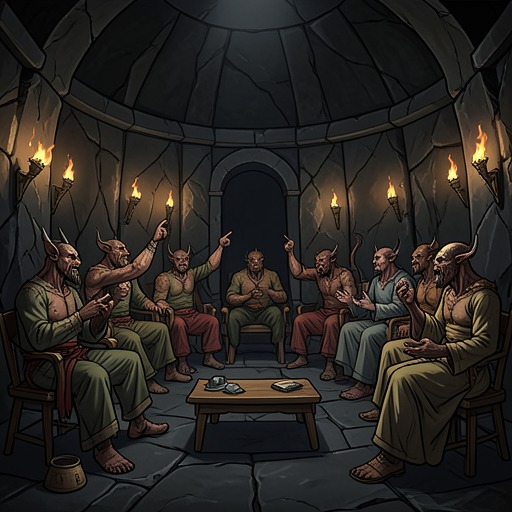
The Rebel Angels' political language repeatedly converts dependence into supposed equality. Satan insists that force has defeated only half an enemy and proposes fraud or guile as the next instrument of war. He also imagines that God intends to create new worlds and a favored generation, giving the host a prospective target beyond Hell. Their council therefore does not accept submission as a possible conclusion. It treats continued war, whether open or concealed, as the only honorable response to defeat.
This rhetoric becomes more explicit when Satan gathers his powers at the Mountain of Congregation under the pretense that they are preparing to receive the Messiah. He tells the celestial orders that the Son of God has been granted supreme authority and asks whether beings who are free and equal should bend the knee to a monarch. The argument is deliberately seductive: hierarchy is recast as oppression, obedience as servility, and self-government as the natural right of every spirit. Yet the claim conceals the fact that Satan seeks dominion for himself. His language of liberty therefore becomes a vehicle for a new imperial ambition rather than a defense of non-dominating freedom.
Abdiel alone among the assembled Seraphim directly answers this argument. He maintains that the decree granting the Son of God royal authority is just, that God created the angelic powers as they are, and that their dignity is not diminished by the Son's reign. On the contrary, the Son's headship unites and enlarges their glory. The Rebel Angels refuse to accept this reasoning. Satan answers that they are self-begotten and self-raised, denying their created dependence and treating their own power as their own right. Their organization is consequently held together not by truth or shared service but by a common refusal of creaturely limits.
Military Action and Defeat
The Rebel Angels fight in the War in Heaven as a vast, highly structured host. Their commanders include Satan and other infernal leaders, while the opposing forces are led by the loyal angels of Heaven. In battle, Gabriel defeats Moloch, and Uriel and Raphael overcome powerful opponents. Abdiel also strikes against the atheist forces. These encounters show that the fallen host possesses formidable strength and martial skill, but its resistance is ultimately separated from truth and justice.
The battle exposes a decisive difference between the two armies. The Rebel Angels can be wounded, pained, frightened, and driven into flight because their disobedience has altered their former condition. The loyal angels, by contrast, stand invulnerable and unwearied, protected by innocence. When night imposes a truce, the Rebel Angels withdraw into darkness and call another council, interpreting their partial endurance as evidence that God can be resisted. Their reasoning refuses the meaning of defeat: wounds that close are treated as proof of imperishability, and survival is mistaken for victory.
After the fall, the host also demonstrates a practical capacity for construction and technological labor. At Satan's command, its members draw flaming swords and prepare for renewed operations. Mammon leads a brigade to a burning hill whose metallic ore can be mined; his followers excavate the mountain and open a spacious wound in it to obtain gold. This labor converts Hell's material landscape into an industrial resource and connects infernal wealth with the human desire to ransack the earth for treasure. The Rebel Angels are therefore not merely a ruined army. They are a disciplined, inventive, and materially ambitious society capable of turning punishment into infrastructure.
Influence on Humanity and the Larger Plot
The Rebel Angels' campaign extends beyond military opposition to God. After wandering over Earth by divine permission, they corrupt much of humanity through falsehoods and lies. They persuade people to abandon God, transform created things into images of brutes, and worship devils as deities through religions adorned with pomp and gold. Their power works by substitution: false names replace erased heavenly identities, idols replace the invisible Creator, and outward ceremony replaces genuine devotion.
Their influence also appears in political history. The fallen powers establish seats and altars near those of God, profane sacred rites, and become associated with pagan worship among the nations. Moloch leads human beings toward blood sacrifice; other infernal powers entice communities into lust, violence, and idolatry. The group thus reproduces its original rebellion within human societies, encouraging creatures to claim authority that has not been given to them and to turn desire for glory into domination.
The same pattern reaches the story of human empire. Adam later learns that a proud descendant will reject the equal and fraternal condition of human beings, claim dominion over his brethren, and use war to force submission. The Tower of Babel then becomes an image of collective self-exaltation: human builders attempt to raise a structure toward Heaven and secure a name for themselves. Although this later tyranny belongs to humanity, it repeats the Rebel Angels' logic of unauthorized sovereignty. The organization therefore functions as a prototype for both spiritual rebellion and worldly despotism.
Defeat, Continuance, and Thematic Significance
The Rebel Angels are defeated, but their defeat is never simple annihilation. They retain immortality, intelligence, military memory, and the ability to change form. Their fall removes heavenly glory and peace while leaving intact the will that produced rebellion. This makes them a continuing threat: a force whose external power has been reduced but whose inner hostility has become more concentrated.
Their central strategy changes from force to corruption. Satan acknowledges that direct violence has not overcome God and turns toward covert design. The later Christian answer to this strategy is not another contest between equal powers. The Son of God offers life for human life, accepts incarnation and death, rises again, and defeats Sin and Death, the principal powers through which the Rebel Angels' work has operated. The redemption promised to humanity therefore reverses the economy of the rebellion: the fallen host seeks gain through pride, conquest, and deception, while salvation proceeds through willing sacrifice, obedience, and grace.
The group's ultimate significance lies in the contrast between appearance and legitimacy. The Rebel Angels look like princes and speak as advocates of freedom, but their freedom is severed from reason, truth, and obedience to the order that created them. Their collective story warns that resistance to tyranny cannot be identified with every refusal of authority. A rhetoric of equality may conceal the desire to rule; survival may be mistaken for triumph; and the pursuit of glory may turn a defeated community into an engine of oppression. Through the Rebel Angels, the poem makes rebellion both a cosmic event and a recurring structure in the spiritual, political, and historical life of the world.